TR2026-116
AB-PINNs: Adaptive-Basis Physics-Informed Neural Networks for Residual-Driven Domain Decomposition
-
- , "AB-PINNs: Adaptive-Basis Physics-Informed Neural Networks for Residual-Driven Domain Decomposition", Machine Learning: Science and Technology, DOI: 10.1088/2632-2153/ae8638, Vol. 7, No. 045025, July 2026.BibTeX TR2026-116 PDF Software
- @article{Botvinick-Greenhouse2026jul,
- author = {Botvinick-Greenhouse, Jonah and Ali, Wael H. and Benosman, Mouhacine and Mowlavi, Saviz},
- title = {{AB-PINNs: Adaptive-Basis Physics-Informed Neural Networks for Residual-Driven Domain Decomposition}},
- journal = {Machine Learning: Science and Technology},
- year = 2026,
- volume = 7,
- number = 045025,
- month = jul,
- doi = {10.1088/2632-2153/ae8638},
- url = {https://www.merl.com/publications/TR2026-116}
- }
- , "AB-PINNs: Adaptive-Basis Physics-Informed Neural Networks for Residual-Driven Domain Decomposition", Machine Learning: Science and Technology, DOI: 10.1088/2632-2153/ae8638, Vol. 7, No. 045025, July 2026.
-
MERL Contacts:
-
Research Areas:


Abstract:
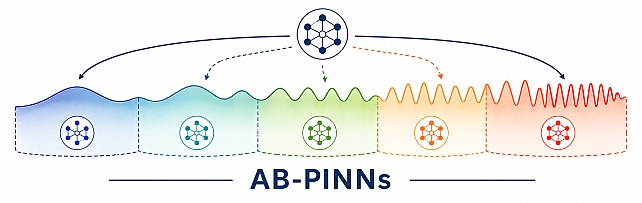
We introduce adaptive-basis physics-informed neural networks (AB-PINNs), an adaptive domain decomposition framework for PINNs in which learnable subdomains dynamically evolve during training to align with intrinsic features of the unknown solution. Local networks capture fine-scale features within each adaptive subdomain, while a global network learns large-scale solution structures. Furthermore, drawing inspiration from classical adaptive mesh refinement, we also modify the domain decomposition on-the-fly throughout training by introducing new subdomains in regions of high residual loss, thereby providing additional expressive power where needed. Our flexible approach to domain decomposition is well-suited for multiscale problems, as different subdomains can learn to capture different scales of the underlying solution. Moreover, the ability to introduce new subdomains during training helps prevent convergence to unwanted local minima and can reduce the need for extensive hyperparameter tuning compared to static domain decomposition approaches. Throughout, we present comprehensive numerical results demonstrating the rapid convergence of AB-PINNs compared with standard PINNs and existing, static PINN-based domain decompositions when solving multiscale differential equations.
Software & Data Downloads
Related Publication
- @article{Botvinick-Greenhouse2025oct,
- author = {Botvinick-Greenhouse, Jonah and Ali, Wael H. and Benosman, Mouhacine and Mowlavi, Saviz},
- title = {{AB-PINNs: Adaptive-Basis Physics-Informed Neural Networks for Residual-Driven Domain Decomposition Jonah Botvinick-Greenhouse, Wael H. Ali, Mouhacine Benosman, Saviz Mowlavi}},
- journal = {arXiv},
- year = 2025,
- month = oct,
- url = {https://arxiv.org/abs/2510.08924}
- }