TR2026-139
Dual-Geometry Manifolds for Few-shot RIR Prediction
-
- , "Dual-Geometry Manifolds for Few-shot RIR Prediction", Interspeech, September 2026, pp. 2963-2967.BibTeX TR2026-139 PDF Software
- @inproceedings{Bhosale2026sep,
- author = {Bhosale, Swapnil and Wichern, Gordon and Masuyama, Yoshiki and Chatterjee, Moitreya and Boeddeker, Christoph and Richter, Julius and Zhu, Xiatian and {Le Roux}, Jonathan},
- title = {{Dual-Geometry Manifolds for Few-shot RIR Prediction}},
- booktitle = {Interspeech},
- year = 2026,
- pages = {2963--2967},
- month = sep,
- issn = {2958-1796},
- url = {https://www.merl.com/publications/TR2026-139}
- }
- , "Dual-Geometry Manifolds for Few-shot RIR Prediction", Interspeech, September 2026, pp. 2963-2967.
-
MERL Contacts:
-
Research Areas:






Abstract:
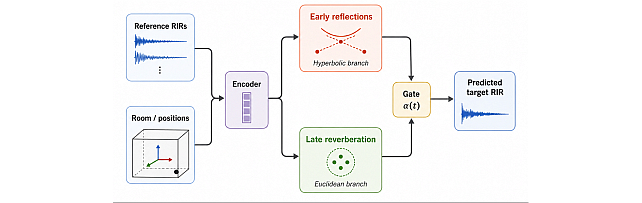
Few-shot room impulse response (RIR) prediction estimates target acoustics from sparse reference RIRs. Current models fuse references in a static Euclidean space, assuming a zero-curvature latent geometry for all temporal phases of the RIR. Using Gromov d-hyperbolicity, we show the acoustic manifold’s geometry evolves from a hierarchical tree structure during early reflections to a flat, diffuse late reverberation tail. Motivated by this heterogeneity, we propose Janus-RIR, a temporally gated, dual-geometry aggregation model. It employs a hyperbolic branch for early reflections and a Euclidean branch for smooth statistical averaging of the late tail, governed by a context-aware dynamic gate. Experiments on AcousticRooms show Janus-RIR achieves state-of-the-art. Aligning latent geometry with the physics of acoustics improves speech clarity (C50) while reducing late reverberation (T60) error by 26% over Euclidean baselines, adapting to environment-specific mixing times.